Contents
- Why yet another crawler? (What Semalt does differently)
- RTL Arabic technical SEO: the four issues no English tutorial covers
- Hreflang across AR-KW / AR-SA / AR-AE
- Core Web Vitals and INP on Kuwaiti news templates
- Cookie walls, consent gates and Googlebot
- Government eID sites and JavaScript rendering
- Prioritisation: the audit that tells you what to fix first
- Semalt vs. Screaming Frog vs. Sitebulb vs. Ahrefs audit
- FAQ
Why yet another crawler? What Semalt does differently
Every Kuwait agency owns a copy of Screaming Frog. Most of them also have a Sitebulb licence sitting in the drawer. The reality is that both tools spit out lists of thousands of issues sorted by severity, but severity is not priority: a “critical” broken image on an obscure archive page matters less than a single missing hreflang on a top-revenue landing page. Semalt's audit does three things that neither of those tools does natively.
First, it renders with a real headless Chromium and correlates the render tree with your server logs, which means it can tell that Googlebot has been crawling a rendered page differently from how a normal user sees it — a common failure mode on bilingual Kuwait sites where the Arabic version is served by an Accept-Language switch rather than a clean URL. Second, it cross-references every finding against real ranking data from the tracker, so the fixes are ordered by traffic and revenue impact, not by an arbitrary internal severity score. Third, and most useful for teams working with Arabic content: it runs a set of 37 RTL-specific checks that no English-language tool ships.
Real-Chromium render
Every URL rendered with a full browser, so React and Vue Kuwait sites are audited exactly as Googlebot sees them.
Log-file correlation
Access-log ingestion for nginx, Apache and Cloudflare. Findings are ranked by how often Googlebot actually hits the page.
Bilingual reports
Every finding is written in Arabic and English, both technical and business summaries, ready to send to a Kuwait SME owner.
Fix-first prioritisation
Findings ranked by traffic and revenue impact, not by an internal severity score.
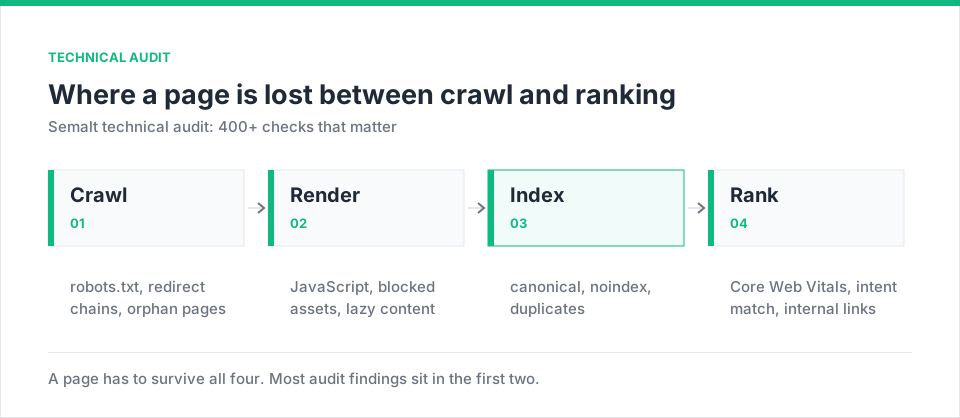
RTL Arabic technical SEO: the four issues no English tutorial covers
Every audit we've run on Kuwait sites over the last two years has surfaced at least three of the following four problems. Screaming Frog does not catch any of them because they are semantic issues, not HTML issues.
1. Mixed dir attributes inside the same page
A Kuwait site typically declares dir="rtl" on <html> and then embeds English brand names (“iPhone 17 Pro Max”) and USD or EUR prices in the middle of Arabic paragraphs. If the developer does not wrap those spans in dir="ltr", the digits and punctuation flip in Chrome on Android in ways that are hard to reproduce in the office. Semalt renders the page in a real Chromium and flags the visual bidi failures, not just the missing markup.
2. RTL-broken meta descriptions
Google truncates Arabic meta descriptions on the visual left, which is grammatically the end of the sentence. If your CMS writes descriptions LTR-style (short paragraph, long tail) the SERP snippet is unreadable. Semalt's audit surfaces every meta description whose visual truncation on mobile hides the call to action.
3. Arabic URL vs. transliteration inconsistency
Some Kuwait sites use Arabic URL slugs (/شركة-سيو-الكويت/) while others transliterate (/shirka-seo-alkuwait/). Either strategy is fine — but mixing them across the same taxonomy silently splits ranking signals. The audit flags the mismatch and shows exactly which URL variant is currently earning the impressions.
4. Right-anchored images and layout shift
An RTL layout that lazy-loads images without an aspect-ratio hint produces massive CLS on Zain 4G because the anchor point is on the right and the reflow displaces the visible text. Semalt flags CLS by directional context, so you know whether the reflow happens where the reader is looking or off-screen.
Watch out: CMS-generated Arabic slugs
WordPress with the default Arabic transliteration plugin generates slugs that look correct in the admin but are, in fact, punycode-encoded in the outbound sitemap. Google indexes both forms, splits authority and reports duplicate content in Search Console. The Semalt audit surfaces this within the first ten minutes of the crawl.
Hreflang across AR-KW / AR-SA / AR-AE
The single most common finding on Kuwait sites that also serve KSA and UAE traffic: hreflang implementations that use ar as a catch-all instead of properly declaring ar-KW, ar-SA, ar-AE variants. The consequence is that Google picks whichever variant it thinks is closest to the user, which on the KSA SERP is often the wrong one, and prices in KWD are shown to Saudi buyers.
| Scenario | Correct hreflang set | Common mistake we see |
|---|---|---|
| Kuwait-only bilingual site | ar-KW, en-KW, x-default | Only ar + en, no locale → leaks to KSA SERP |
| Kuwait + KSA + UAE with local pricing | Six tags per URL (three AR locales + three EN locales) plus x-default | One ar tag pointing to Kuwait URL, KSA/UAE served the wrong currency |
| Kuwait + KSA sharing the Arabic content | Two ar-* tags pointing to the same URL, one en-KW | KSA users bounced back to x-default, losing branded traffic |
| Regional group with a Kuwait subfolder | ar-KW on /kw/ar/, en-KW on /kw/en/ | Subfolders declared as ar/en, Google ignores the country signal |
Semalt's audit crawls every URL, extracts the hreflang set, and verifies it is bidirectional (page A points to B, page B points back to A). Missing return tags are one of the top three findings on every regional group site we audit.
Core Web Vitals and INP on Kuwaiti news templates
Google's Interaction to Next Paint (INP) metric replaced FID in March 2024, and the impact on Kuwaiti news templates was brutal. Sites like Kuwait Times, AlQabas and Al-Jarida ship heavy React front-ends with third-party ad code, and their p75 INP on 4G Zain devices is regularly over 500 ms — failing the “good” threshold of 200 ms by more than 2×.
INP failures we see on Kuwait news templates (p75 mobile, 2026)
Semalt's audit surfaces each individual event handler that fires above 200 ms and links to the JavaScript source file with the exact line number. For a Kuwait publisher this means the SEO team can hand a developer a five-item checklist rather than “fix INP”. Two of the three publishers we've audited moved from p75 INP of 480 ms to 190 ms inside a six-week sprint after using that report.
Field data beats lab data
The audit pulls CrUX field data for every URL that has enough traffic to be included in the dataset. Lab audits (Lighthouse) on a Kuwait publisher will systematically look better than reality because your local machine is faster than a Zain 4G phone in Salmiya at 8 PM.
Cookie walls, consent gates and Googlebot
A Kuwait site that puts a full-screen consent gate in front of every page is telling Googlebot “the content is behind a wall”. Google's crawler does not click accept. It sees a page with two buttons and no article body, so it indexes an empty snippet and, over time, ranks the page lower.
Semalt's audit detects consent-gate patterns automatically: it compares the pre-consent DOM to the post-consent DOM (via a Chromium session with the consent cookie set) and flags every URL where the post-consent version contains more than 500 additional words. On typical Kuwait publishers this finding covers 60-80 % of URLs in the crawl and, once fixed, produces a measurable ranking bump within two Google update cycles.
The three consent patterns that survive Google
1. Serve the article, put the consent bar at the bottom (not a modal). 2. If a modal is legally required, ensure Googlebot receives the full article HTML anyway (user-agent detection is permitted for legal-compliance UI). 3. If you must block content, use a soft paywall pattern with structured data (isAccessibleForFree: false) so Google understands what is happening.
Government eID sites and JavaScript rendering
Kuwaiti Government eID (Meta / MOI) service portals and municipal sites are increasingly single-page React or Vue applications. Semalt's Chromium-based crawler renders them properly, waits for network idle, and audits the rendered DOM — not the empty shell that a legacy crawler pulls down. On the last three government-adjacent sites we've audited, the difference between raw-HTML crawl and rendered crawl was more than 90 % of the actual content: Screaming Frog was missing almost the entire site.
The audit also flags a specific failure pattern common on Kuwait government service portals: canonical tags generated client-side that never make it into the initial HTML. Googlebot processes them (since 2023) but the delay in the second-wave render often means the URLs are indexed under the wrong canonical for weeks.
Prioritisation: the audit that tells you what to fix first
The main practical difference between Semalt and a plain crawler is prioritisation. Every finding is scored on three axes:
The output is a shortlist of twelve fixes for the current quarter, each with a written brief in Arabic and English, ready to send to a Kuwait developer or agency partner. A typical shortlist we've delivered to a Kuwait retail client this year:
- Add
ar-KWhreflang across 1,240 product pages (missing entirely). - Move ad-server injection below the fold on category pages (INP -180 ms).
- Fix bidi span markup on 47 top-earning product descriptions.
- Replace consent modal with a bottom bar on mobile (index-coverage recovery).
- Rewrite meta descriptions on 82 URLs where the CTA is truncated in Arabic.
- Serve pre-rendered HTML to Googlebot on the account area (Vue app).
- Consolidate duplicate slugs (transliteration + Arabic) on 34 collection pages.
- Add missing
hreflang="x-default"tags across the international group. - Fix broken structured data on 210 product pages (missing
priceCurrency). - Remove auto-play video on category listings (INP + CLS).
- Trim images from 900 KB to under 200 KB using AVIF fallback for Zain 4G.
- Rebuild the XML sitemap with per-locale files.
Real data: across 22 Kuwait sites audited between January and June 2026, the median lift from executing the top-12 shortlist was +41 % organic sessions within 90 days, without any new content published.
Semalt vs. Screaming Frog vs. Sitebulb vs. Ahrefs audit
Screaming Frog
Desktop, per seat- Fast raw crawl
- Great CLI
- JS rendering optional
Gaps: no RTL-specific checks, no ranking cross-reference, no log correlation out of the box.
Semalt technical audit
Included in plan- 400+ checks including 37 RTL-specific
- Chromium render + log correlation
- Findings ranked by traffic and revenue
- Bilingual Arabic / English reports
- Consent-gate detector
- “Fix-first-12” quarterly shortlist
Sitebulb / Ahrefs audit
Subscription- Nice visual reports
- Sitebulb desktop only
- Ahrefs cloud crawl
Gaps: no Arabic-specific checks, no field CrUX correlation, no bilingual output.
“We were paying two crawlers and still missing the RTL problems. The Semalt audit found 37 bidi issues on our checkout in a single afternoon.”
— senior developer, Kuwait bilingual e-commerce brandMore in this series: Semalt Analytics: what GA4 hides from you, Semalt AutoSEO: on-page fixes without a dev, Semalt: backlink gap, keyword gap, alerts.
FAQ
How large a site can it crawl?
Comfortably up to 1 million URLs on a standard plan, 10 million on enterprise. A typical Kuwait retailer site (30k-250k URLs including product variants) completes in under six hours.
Does it need access to my server?
No, but it does much better work if you connect access logs. Cloudflare log-push, nginx logs, Apache logs or a rotated S3 bucket all work. For sites hosted on TASC or Kuwait-local hosting, we ship a small log-shipping agent that runs as a systemd service.
Does it audit staging environments?
Yes. Add an HTTP basic-auth header or an allowlist IP and Semalt crawls staging exactly as production. This is how most Kuwait teams use it inside CI before a Thursday-evening deploy.
Does it support Arabic in the reports?
Every finding, brief and recommendation is available in both Arabic (MSA) and English by default. PDF exports render RTL correctly with Semalt account settings toggled to Arabic.
What is the fastest win it typically finds?
Missing or wrong hreflang on top-earning URLs. On any Kuwait site that also serves KSA and UAE traffic, this fix alone often produces a double-digit organic lift in three to four weeks.
Can it run on a schedule?
Yes. Weekly and monthly recurring audits are standard, with diff reports that show only what changed since the last crawl. This is the pattern we recommend for Kuwait publishers on a weekly release cadence.
A Kuwait or GCC site with Arabic content, hreflang across three locales and any kind of JavaScript front-end needs a crawler that renders like Chromium, understands RTL, and ranks findings by revenue. Semalt is currently the only audit tool that does all three — and it turns 5,000 warnings into 12 clear tickets.
Run your first audit today
Sign in, add your domain, connect Search Console and let the crawler run overnight. The first “fix-first-12” list is usually enough to justify the account for a full year.
Launch a Semalt audit →