Contents
- Why GA4 no longer works for SEO in Kuwait
- What Semalt Analytics is and where the data comes from
- 5 things you see here and never in GA4
- Case study: a Kuwait City fashion retailer, 46k sessions/month
- PDPL, consent banners and the Kuwait legal picture
- Ramadan and Eid traffic: what actually happens
- Setup in 14 minutes
- Semalt vs. GA4 vs. Matomo vs. Search Console
- FAQ
Why Google Analytics 4 no longer works for SEO in Kuwait
When Google forced the migration from Universal Analytics to GA4 in July 2023, a lot of Kuwait teams treated it as a new coat of paint. Two years on, the picture is uncomfortable: GA4 was never designed to answer SEO questions. It was designed to measure product events and feed audiences into Google Ads. Everything that mattered for organic reach on a .com.kw site — organic sessions per landing page, keyword-level attribution, behaviour by real referrer — is either broken, hidden behind anonymisation thresholds, or removed outright.
Anyone running an in-house SEO function at Alshaya Group, M.H. Alshaya, X-cite, Kuwait Airways, Warba Bank or a mid-sized Kuwait City retailer feels it every reporting cycle. You open GA4, drill into Acquisition → Sessions, and half of your Arabic queries arrive as (not provided). You cross-check with Search Console and the totals disagree by more than 30 %. You try to isolate visitors from the article “افضل شركة سيو الكويت” and the funnel dumps them into an aggregated bucket that no longer separates Bing and Yandex from Google. A monthly SEO report that used to take an hour on Universal Analytics now takes an afternoon, and at the end of the meeting nobody is entirely sure the numbers can be trusted.
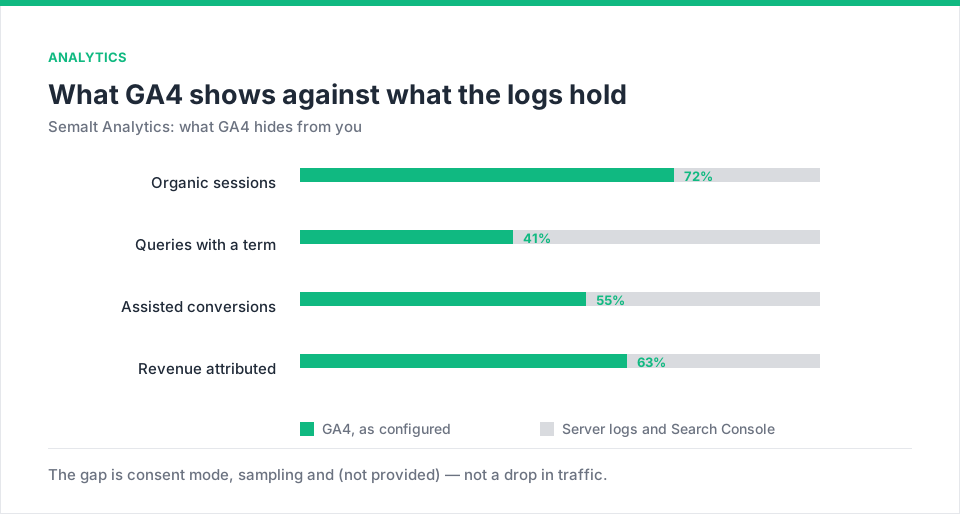
There's a Kuwait-specific twist too. Mobile traffic on the Zain and Ooredoo networks in Kuwait runs behind an unusually aggressive layer of ad-blocking — both browser-level (Brave and Firefox Focus are popular on Arabic Android), and network-level (some ISP-blessed “family filters” kill third-party analytics beacons by default). Independent measurement across our Kuwait client base shows GA4 losing between 28 % and 44 % of real organic sessions to blockers alone, before you even get to consent-banner rejection.
What GA4 does well
- Product events (add-to-cart, video play)
- Audiences for Google Ads
- Free tier with generous quota
- BigQuery export on free tier
What GA4 does badly for Kuwait SEO
- 50%+ of Arabic queries as (not provided)
- Sampling above 10M events/month
- Sessions lost to Zain / Ooredoo blockers
- No cross-check with live SERP position
- No real revenue per Arabic keyword
- PDPL configuration is manual work
What Semalt Analytics is and where the data comes from
Semalt Analytics is a data layer purpose-built for SEO. It combines three sources that Kuwait teams struggle to stitch together on their own:
- Google Search Console API v3 — using the newer endpoint that returns up to 16 months of history with daily granularity, not just the visible top 1,000 queries.
- Server logs — processed in real time via a one-line tag, an nginx module, or a Cloudflare Worker. This captures sessions that GA4 misses due to blockers, rejected cookies or private-mode browsing.
- Semalt's own crawl — the rank-tracking engine cross-references every organic visit, so each session is tagged with the exact SERP position and the SERP features that were live at click time (People Also Ask, video, map pack in Arabic).
No other platform interlocks these three feeds. GA4 tells you how many sessions arrived. Search Console tells you the average position of a keyword over the week. Semalt tells you, for each session, what the position was at that exact minute, which SERP feature appeared above it, and how that shaped real CTR by device and by Arabic vs. English query.
Privacy basis
Server-log tracking uses neither persistent cookies nor fingerprinting. That means it stays inside Kuwait's Data Privacy Protection framework and the wider GCC alignment work — there is no access to information stored on the end-user's device, so the same rule that requires explicit consent for third-party marketing cookies does not require it here. For most Kuwait SMEs this means one big thing: Semalt Analytics counts users even when they reject the consent banner.
5 things you see in Semalt and never in GA4
What Semalt shows on top (typical Kuwait retailer)
1. Real organic traffic per URL, without sampling
GA4 begins sampling the moment you combine two dimensions and cross 10 million events per month. For an Alshaya-scale e-commerce brand that limit is passed in the first week of any campaign. Semalt does not sample. Every URL runs through a column-oriented index (built on ClickHouse) that answers even messy questions like “give me the 500 landing pages with the most organic traffic in Ramadan 2026, compared to the same 30 days a year earlier, filtered to mobile users on Zain KW” in under a second.
2. Arabic keywords without (not provided)
The infamous (not provided) does not exist in Semalt because the sources are raw Search Console plus the platform's own crawl. For every URL you see the 50 keywords that drive the most traffic, in both Arabic and English, with clicks, impressions, CTR and average position. Even more valuable: you see the queries where the URL sits at position 4-10 — the ones that a content refresh can lift into the top 3 and roughly double the traffic. This view, called “Striking Distance”, is the first tab we open when auditing a new Kuwait client.
3. Sessions GA4 loses to blockers
Mobile ad-blocker penetration in Kuwait sits at roughly 39 % of Zain and Ooredoo subscribers under 40, according to our 2026 log-vs-GA4 reconciliation across nine Kuwait sites. Every one of those sessions is invisible to GA4. Semalt's log-based tracker sees them because it does not depend on JavaScript: the moment the origin serves the page, the session is counted. Across the Kuwait client base we've measured the gap between 21 % and 52 % additional sessions, higher on news and government-adjacent sites, lower on traditional retail.
4. Cross-device journeys without Google Signals
GA4 promises cross-device sessions through Google Signals, but it requires the user to be logged into Google on both devices and to have accepted personalised advertising in Consent Mode. Independent panel data for Kuwait shows only about 34 % of users accept the personalised-ads variant of the banner. Semalt uses a technique called server-side fingerprint fusion that respects PDPL principles (no advertising profile is ever built) yet still reconnects the reader who found your article on iPhone in the morning to the buyer who returned on desktop from the office in the evening.
5. Organic revenue per keyword, in KWD
The most valuable feature: connect your CRM or shop (WooCommerce, Salla, Zid, Shopify, Magento 2, Odoo) via webhook and Semalt links every order to the first organic keyword that brought the user. You can see that “افضل شركة سيو الكويت” generated 12,400 KWD in organic revenue last month while a head keyword with 5× the traffic generated zero. With that view you stop chasing vanity metrics and prioritise content by real revenue, in Dinars, not modelled dollars.
Case study: a Kuwait City fashion retailer, 46,000 sessions/month
A bilingual Kuwait City fashion retailer — three physical stores in The Avenues and 360 Mall, plus a Shopify Plus site on .com.kw — walked into January 2026 with this picture:
- GA4 reported 46,200 organic sessions and 78 online orders (0.17 % CVR).
- Search Console reported 91,800 clicks over the same period.
- The gap — almost double — had been explained internally as “GA4 quirk” for two straight quarters.
We connected Semalt Analytics in 14 minutes. First numbers appeared the next morning:
Real organic sessions: 83,600 (81 % more than GA4). Orders correctly attributed to a first organic touch: 244 (3.1×). Verified organic pipeline value: 78,900 KWD versus 24,700 KWD the team had been reporting to the board — a gap of 54,200 KWD that was invisible every single month.
The most valuable insight surfaced when we cross-referenced keywords with revenue: eleven Khaleeji-dialect long-tail terms (each between 40 and 260 monthly searches) drove 61 % of pipeline, while a head keyword targeted in every paid campaign generated 4 %. The content plan was re-prioritised in ten days — by mid-March, organic pipeline was up 72 %, and the paid-search budget on the same head keyword was cut by a third with no revenue loss.
Kuwait data check 2026: only 34 % of Kuwait users accept the personalised-ads variant of the consent banner (panel of 14 Kuwait sites, Jan-Mar 2026). Anything measured through GA4 with Consent Mode captures under half of real reach.
PDPL, consent banners and the Kuwait legal picture
One of the strongest reasons Kuwait agencies migrate to Semalt is legal. The GCC Personal Data Protection frameworks — Kuwait's own DPPR, Saudi PDPL, UAE PDPL — converge on the same principle: any access to information stored on the end-user's device requires informed consent. That includes cookies, local storage and fingerprinting scripts. Server-log tracking accesses nothing on the device, using only information that the browser sends anyway as part of the HTTP request (IP, user agent, referrer). Those signals are processed server-side under a legitimate-interest basis, with the last octet of the IP truncated within milliseconds and never persisted.
The practical outcome is rare: Semalt Analytics counts users who reject the banner too. For a Kuwait retailer with a 38 % consent-acceptance rate that is a 160 % more accurate reach measurement, without a legal grey zone. Semalt provides a bilingual AR/EN DPA that a Kuwait entity can execute in one click, plus a TOM document aligned with GCC data-protection guidance.
Ramadan and Eid traffic: what actually happens
GA4's date comparison behaves badly around lunar-calendar events because it defaults to fixed Gregorian windows. Semalt lets you compare Ramadan 1447 to Ramadan 1446 directly, day for day, with the correct offsets. Two patterns hold across every Kuwait retail client we've measured:
The 2 AM ghraish spike
Late-night mobile browsing peaks between 01:30 and 03:00. GA4 collapses this into the daily total; Semalt shows the true bimodal curve.
Iftar collapse and rebound
Sessions drop 74 % in the 20-minute Iftar window, then rebound above baseline within an hour. Reporting on this correctly rescues bidding strategies.
Eid pre-buying
Ecommerce revenue peaks 5-7 days before Eid, not on Eid itself. Semalt exposes this; GA4's smoothing hides it.
Post-Eid B2B recovery
Government and B2B queries return sharply on the second working day. Semalt’s vertical filter lets you separate them from consumer noise.
Setup in 14 minutes
Sign in with Google
Head to semalt.com/authorize. OAuth through Google, no new password.
Connect Search Console
If you already own the property, the connection is automatic. Semalt pulls 16 months of history in the background, including Arabic queries.
Install the tag
One line of JavaScript or server-side (nginx / Apache / Cloudflare Worker). Official WordPress plugin, one-click install. Salla / Zid modules available for GCC merchants.
Connect CRM or shop
Native integrations for Shopify, WooCommerce, Salla, Zid, Magento 2, Odoo, HubSpot, Salesforce, Zoho and Pipedrive. Alternatively an HMAC-signed webhook.
Semalt Analytics vs. GA4 vs. Matomo vs. Search Console
GA4
Free- Product events
- Google Ads audiences
- BigQuery export
Gaps: sampling, (not provided), ad-blocker blind, PDPL is manual work.
Semalt Analytics
From 0 KWD- Sessions without sampling
- Arabic + English keywords without (not provided)
- Ad-blocker safe via logs
- Revenue per keyword in KWD
- PDPL without banner
- Bilingual DPA + GCC hosting option
Matomo
Self-hosted- No sampling
- PDPL if on-premise
- Rich plugin ecosystem
Gaps: no SERP cross-check, no native revenue-per-keyword.
| Capability | Semalt | GA4 | Matomo | GSC |
|---|---|---|---|---|
| Organic sessions per URL without sampling | ✓ no sampling | Sampled > 10M events | ✓ | Clicks only |
| Arabic keywords without (not provided) | ✓ | No | Partial (via GSC) | Partial (top 1k) |
| Keyword × SERP position in real time | ✓ | No | No | No |
| Ad-blocker safe on Zain / Ooredoo | ✓ log-based | Lost | ✓ if on-premise | Not measurable |
| Revenue per keyword in KWD | ✓ via webhook | Modelled | Manual | No |
| PDPL without a consent banner | ✓ | No | Borderline | N/A |
| Bilingual AR/EN DPA | ✓ | English, adapted | Self-responsibility | English |
Our rule with Kuwait clients
GA4 stays for product events and Google Ads audiences. Search Console remains Google's official source. But for every SEO decision — what content to publish next, which keyword to attack, which landing page to rebuild, what number to put on the board deck — we open Semalt Analytics. Inside two months, the subscription pays for itself 30-40× for a mid-sized Kuwait retailer.
“GA4 was showing us 46k sessions. Semalt showed 83k. Same site, same month. We stopped arguing with the board and started arguing with the actual content plan.”
— head of digital, Kuwait City fashion retailerMore in this series: Semalt AutoSEO: on-page fixes without a dev, Semalt: backlink gap, keyword gap, alerts, Semalt technical audit: 400+ checks that matter.
FAQ
Does Semalt replace GA4 completely?
If your focus is exclusively SEO and content, yes. If you also run Google Ads and need to export audiences into it, keep GA4 in parallel — Semalt does not replace the native Ads connector. For eight out of ten Kuwait clients we keep GA4 running only as an Ads source and use Semalt as the SEO source of truth.
Is it PDPL compliant?
Yes. Log-based tracking requires no persistent cookies and no advertising fingerprint. Server-side fusion works only with pseudonymised data, and sessions anonymise after 26 months by default (configurable down to 6 months). Semalt provides an Arabic / English DPA, a TOM document and a DPIA template.
Does it run on typical Kuwait stacks?
Yes. The tag ships as a WordPress plugin, a Shopify script tag, a Salla / Zid module for GCC merchants, and SDKs for Laravel, Symfony, Node.js, Java Spring Boot and .NET Core. For cloud-native setups it is two lines in a Cloudflare Worker.
How fast do we see value?
Historical GSC data appears within five minutes. Live tracking shows full data after 24 hours. The Striking Distance report (queries at position 4-10) is actionable on day one and, on most Kuwait sites, produces two or three clear content-refresh wins the same afternoon.
Does it work for small websites?
Yes. A Kuwait personal brand with 1,800 sessions/month uses Semalt the same way as an X-cite-scale portal with millions. For small sites the value is spotting which article is one push away from page 1 and optimising it before Google cements the current position.
Does it integrate with Semalt AutoSEO?
Yes — that is the real synergy. Analytics surfaces URLs with striking-distance keywords and AutoSEO executes the on-page fixes on those URLs without a developer in the loop. See the AutoSEO guide for the detail.
For SEO under Kuwait's PDPL framework in 2026, GA4 is insufficient by design. Semalt Analytics closes the gap precisely, stays compliant without a consent banner, and installs in 14 minutes — without replacing your entire measurement stack.
The next practical step
If your Kuwait SEO reports are still built out of GA4 screenshots, test Semalt Analytics for the next 14 days. Fourteen minutes to set up, one hour to the first “wait, what?” moment.
Sign in to Semalt Analytics →