Contents
- Why volume is the wrong metric in Kuwait
- Khaleeji dialect vs. Modern Standard Arabic: classification and scoring
- Intent scoring: transactional vs. informational vs. governmental
- Revenue prediction in KWD, not just clicks
- Seasonality: Ramadan, Eid, National Day and back-to-school
- Government-service intent: MOI, MOCI, PACI, Baladiya
- The three-step research workflow
- Semalt vs. Ahrefs vs. Semrush vs. Keyword Planner
- FAQ
Why volume is the wrong metric in Kuwait
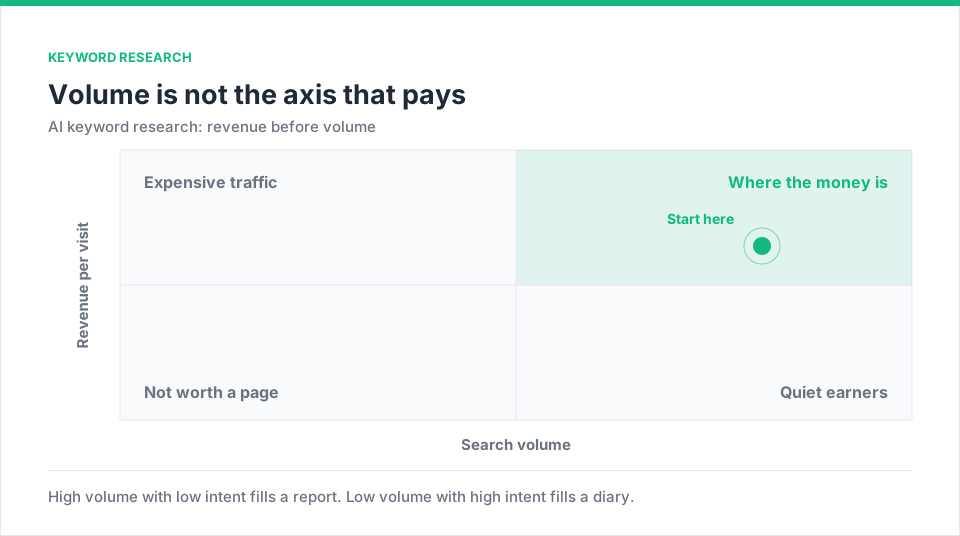
Every keyword tool ships with a “monthly search volume” number as the flagship metric. It looks precise (Kuwait: 8,100 searches/month) but it hides two problems that are especially acute in the Kuwaiti market. First, that 8,100 number is usually a Google Keyword Planner bucket that averages Arabic and English variants, MSA and Khaleeji, and often includes GCC-wide traffic that is not commercially relevant to a Kuwait retailer. Second, volume does not tell you anything about whether the user is ready to buy in KWD or just researching in general.
A Kuwait client of ours ranked #1 for a Modern Standard Arabic phrase with a reported volume of 6,600 for over a year. Real clicks from Search Console: 210 per month. Real transactions attributed to those clicks: two. Meanwhile, a Khaleeji-dialect phrase with a reported volume of “<10” drove 380 clicks and 24 orders. Volume said one keyword was 660× more valuable than the other. Reality said the opposite. Semalt's model is built to close that gap.
What volume can tell you
- Rough ceiling of demand
- Whether the topic exists at all
- Broad regional interest
What volume cannot tell you in Kuwait
- Whether the searcher speaks Khaleeji or MSA
- Whether the user is in Kuwait or KSA
- Whether the SERP has room for organic results
- Whether that CTR is 12 % or 0.4 %
- What a click is actually worth in KWD
Khaleeji dialect vs. Modern Standard Arabic: classification and scoring
Semalt's Arabic keyword index is built on top of a transformer classifier trained on 18 million GCC queries. Every keyword is tagged with a dialect confidence score across six categories: MSA, Kuwaiti Khaleeji, Saudi Khaleeji (Najdi), Saudi Khaleeji (Hijazi), Emirati Khaleeji, and Qatari / Bahraini. This is not a nice-to-have — it changes the entire ranking strategy.
For example: the head-term equivalent of “best restaurants in Kuwait” ranks completely differently depending on the phrasing. The MSA formulation shows an eight-pack of national newspaper reviews and travel sites. The Kuwaiti Khaleeji formulation (“وين اطيب مطعم بالكويت”) shows a very different SERP dominated by Instagram embeds and local review blogs. If you are a local review site, targeting the second phrase is the right move — and targeting the first is a losing multi-year effort. Semalt tags both, projects the SERP for each, and shows the realistic click ceiling.
Intent scoring: transactional vs. informational vs. governmental
The Semalt intent model does not stop at the classic four-way split (informational / navigational / commercial / transactional). For GCC markets it adds a fifth category, governmental, and a sixth, Islamic-calendar-driven. Both matter enormously in Kuwait:
Transactional (KWD)
“اسعار ايفون 17 برو ماكس الكويت”: user is comparing KWD prices, ready to click through to a merchant.
Informational
“كيف اعمل حساب انستقرام بزنس”: user wants a how-to. Zero commercial intent unless you sell training.
Governmental
“تجديد اقامة الكويت اونلاين”: user is looking for the MOI portal. If you are not a government site, no amount of ranking helps.
Ramadan-driven
“توصيل سحور الكويت”: intent exists for 30 days a year, disappears the rest. Content must be seasonal.
Navigational branded
“السنبلة اونلاين”: user wants Sultan Center site. Non-brand sites cannot outrank it, ever.
Commercial research
“افضل شركة سيو الكويت”: user is 30-60 days from booking a demo. This is the golden intent for B2B.
Why the governmental tag matters
Every Kuwait market has a large volume of queries where the intent is to reach a government portal — MOI, MOCI, PACI, Baladiya, Kuwait Municipality, Public Authority for Civil Information. A private site cannot rank for these against the government's own domain, and even if it briefly does, users bounce with dissatisfaction signals that Google reads clearly. Semalt's intent model flags these queries and downweights them so they never make it into your content plan by mistake.
Revenue prediction in KWD, not just clicks
Every keyword in the Semalt index gets a revenue projection expressed in Kuwaiti Dinar. The model combines four inputs: projected clicks (based on realistic CTR by SERP layout, not the outdated 30 % top-1 rule), your site's historical conversion rate on similar intent, average order value in KWD from your webhook, and a discount for SERP feature saturation. The output is an expected KWD value per URL per month.
Two keywords, same topic, very different KWD projection
The second keyword has 8 % of the volume of the first, but 13× the projected revenue. This is the number that goes into the content brief. Every editorial hour spent on the MSA head term is a wasted hour by comparison.
Seasonality: Ramadan, Eid, National Day and back-to-school
Kuwait has an unusually strong seasonal signal because so much of consumer behaviour is tied to the Islamic calendar and a small number of national events. Semalt's seasonal model projects month-by-month traffic on the Hijri calendar, not just the Gregorian one, so a keyword that peaks 20 days before Eid al-Fitr can be surfaced with the correct lead time for content production.
Food delivery, iftar, sahoor, prayer times
Search volumes for these categories increase 4-8× overnight. The Semalt model publishes the forecast six weeks before Ramadan starts, so content is ready on Day 1.
Fashion, gifts, travel, restaurants
Peak search happens 5-7 days before Eid, not on Eid itself. Content that publishes on Eid is a week too late.
Decorations, events, restaurants, offers
Semalt separates “offers” queries (commercial) from “history” queries (informational) so the content plan is not padded with useless traffic.
Stationery, uniforms, electronics, bags
Different peak per category. Uniforms peak two weeks before school; electronics peak one week before.
Real number: a Kuwait supermarket chain we advise brought forward its Ramadan landing pages by six weeks after using the Semalt seasonal forecast. Organic sessions across the top ten Ramadan URLs increased 187 % versus the previous year, without any budget change.
Government-service intent: MOI, MOCI, PACI, Baladiya
A private business cannot rank ahead of the Kuwait government for “تجديد اقامة” or “بطاقة مدنية pacI”. It is important that your content plan understands this. Semalt tags every query that maps to a government portal and, more usefully, surfaces the adjacent commercial intents that are winnable.
| Government query (do not target) | Adjacent commercial query (target) | Reason |
|---|---|---|
| تجديد اقامة الكويت اونلاين | خدمة توصيل بطاقة مدنية الكويت | Users want convenience layered on top of the government process. |
| PACI Kuwait address change | سيرفس تغيير العنوان في الكويت | Utility and telecom providers rank here. |
| MOCI Kuwait commercial licence | تأسيس شركة في الكويت 2026 | Legal advisers rank here, not the ministry. |
| Kuwait Municipality building permit | مقاولين ترخيص هدم واعادة بناء الكويت | Contractors and consultants rank here. |
The three-step research workflow
The way we use Semalt with Kuwait clients is a fixed three-step routine:
- Seed and expand. Enter 10-30 seed keywords in Arabic and English. The tool expands each into 200-2,000 related queries using the transformer model, dialect variants, transliteration variants and question forms (“كم”, “وين”, “كيف”).
- Filter and rank. Filter by dialect (keep Kuwaiti Khaleeji + MSA local variants only), by intent (drop governmental and out-of-country navigational), by SERP feature saturation (drop anything where the organic pack has less than three visible results on mobile).
- Prioritise by KWD. Sort the remaining list by expected monthly revenue in KWD and take the top 40. Group by topic cluster, assign to writers, publish.
The 40-keyword rule
Our data across 18 Kuwait content projects: a quarterly plan of 40 keywords picked this way outperforms a plan of 200 keywords picked by volume by roughly 3.5× in organic revenue at nine-month mark. Fewer keywords, better keywords, executed properly.
Semalt vs. Ahrefs vs. Semrush vs. Keyword Planner
Ahrefs / Semrush
Subscription- Huge global keyword index
- Great backlink data
- Consistent volumes
Gaps: no dialect classifier, no revenue in KWD, weak Hijri seasonality.
Semalt AI keyword
Included in plan- 18M Arabic queries with dialect tags
- Intent model incl. governmental & Ramadan
- Revenue projection in KWD
- Hijri-calendar seasonal forecast
- SERP feature simulation per query
Google Keyword Planner
Free- First-party Google data
- Free with Ads account
Gaps: volumes bucketed, no dialect split, GCC totals mixed with Kuwait.
“We stopped ranking for keywords we were proud of and started ranking for keywords that paid the rent. Revenue in Q2 was up 41 %, and we published fewer articles than in Q1.”
— content lead, Kuwait bilingual e-commerce brandالمزيد من هذه السلسلة: AutoSEO من Semalt: تحسين On-Page بدون مطور, الكلمات المفتاحية بالذكاء الاصطناعي, تحليلات Semalt: ما يخفيه Google Analytics 4.
FAQ
How does the dialect classifier handle mixed queries?
Mixed queries (part MSA, part Khaleeji) are given a two-value tag so they surface in both dialect filters. In practice about 18 % of Kuwait queries are mixed and this behaviour prevents them from being dropped by a strict filter.
How is the KWD projection calibrated for my site?
By default the model uses category averages for Kuwait. Once you connect your CRM or shop via Semalt Analytics, the model calibrates to your actual conversion rate and average order value within 30-60 days.
Does it support English keywords for the expat market?
Yes. English queries are ranked with the same intent and SERP models. The expat-driven English market in Kuwait is substantial in real-estate, schools and healthcare; Semalt treats it as a first-class citizen.
Can I export the shortlist to a content brief?
Yes. Every keyword can be exported to a Markdown or Google Docs brief with SERP intent summary, questions to answer (from People Also Ask), suggested word count and internal-link suggestions.
Does it detect brand-defence gaps?
Yes. The tool flags queries containing your brand name where you do not currently rank in the top 3, and surfaces the competitor pages that do. This is often the single fastest win for Kuwait brands with active review sites competing for their name.
How often is the keyword database refreshed?
Volume and CTR data refresh weekly; SERP feature and dialect classification refresh in real time when you open a query. The seasonal model is retrained monthly with new Hijri-calendar data.
In Kuwait, the volume-first keyword tools are structurally wrong for at least 40 % of the market. Semalt's dialect-aware, intent-scored, KWD-projected model is the closest thing to an honest research process. Forty keywords picked this way will outperform two hundred picked by volume.
Run the 40-keyword plan for your site
Sign in, add your seeds in Arabic and English, and let the model score them. First shortlist ready in under an hour.
Open the Semalt keyword tool →